IBAM EP 113: Christian Entrepreneurship: God’s Blueprint for Building a Business With Purpose

“I’m not selling, but I’m serving.”
— Rylee Meek
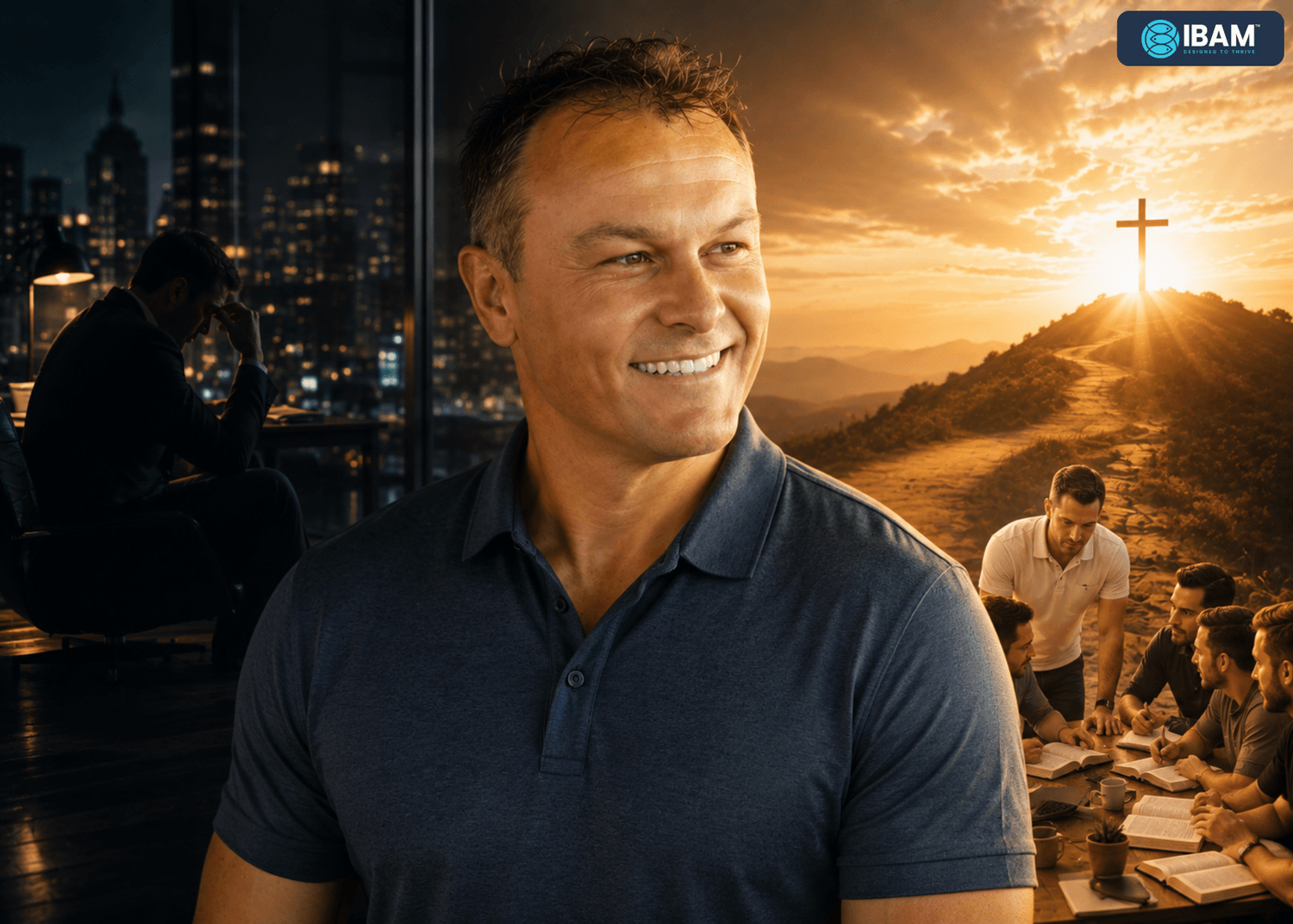
How Rylee Meek moved from financial success and spiritual bankruptcy to discipling entrepreneurs through a biblical framework
Can you be successful in business and still be a faithful Christian?
That question sat at the center of Rylee Meek’s journey.
In this conversation with IBAM host Tom Carter, Rylee shares how his pursuit of entrepreneurship began early, how financial success failed to provide the fulfillment he expected, and how returning to Scripture changed the way he understood business, stewardship, success, faith, and purpose.
Rylee is an entrepreneur, author, speaker, and founder of the King’s Council, a ministry focused on discipling entrepreneurs through a biblical framework.
But the King’s Council did not begin because Rylee had business completely figured out.
It emerged from a season when, by his own description, things looked successful financially while he felt spiritually bankrupt on the inside.
His story raises an important question for Christian entrepreneurs:
What happens when business success is no longer enough?
When Financial Success Still Leaves You Unfulfilled
Rylee says he jokingly describes his early journey this way:
He gave his life to entrepreneurship at age 15 and to Christ at age 16.
For several years, he says he loved Jesus and looked to Him as Savior. But it was much later that he began to understand what it meant for Jesus to be Lord of his life.
That distinction became significant.
Rylee says that in 2019, he was at what he considered the financial pinnacle of his companies.
His view of success at the time was straightforward. He wanted to be able to do what he wanted, when he wanted, where he wanted, with whom he wanted, and how he wanted.
That kind of freedom, he believed, required making a lot of money.
So that became the pursuit.
By 2019, he felt he had achieved much of what he had been chasing.
Yet something was deeply wrong.
He describes himself during that period as spiritually bankrupt.
He had never felt more unfulfilled.
People around him might say, “It must be nice,” but Rylee says they did not know what was happening internally.
Inside, he felt like a train wreck.
That led him to ask a deeper question:
Is this really what life is about?
The Identity Struggle Behind His Business Success
As Rylee built companies and pursued money, he says much of the excitement came from what he calls “the thrill of the hunt.”
But he also recognized another problem.
He had surrounded himself with people who were not necessarily influencing him in the direction he wanted to go.
Instead of being the influencer, he found himself being influenced.
Looking back, he connects that with a lack of discipleship.
One of the biggest struggles underneath all of this was his belief about Christian success.
Could he be successful, in the way he understood business success, and still be a good Christian?
Rylee says he grew up in a small community in South Dakota. His early picture of self-professed Christians was that they were often broke, broken, and defeated.
That shaped his assumptions.
He began to believe that perhaps being a good Christian and creating wealth were incompatible.
At the same time, he felt God had given him an ability to create wealth.
That produced a tension around identity and stewardship.
Was he truly loving God?
Was he pursuing God?
Was he stewarding that ability appropriately?
Those questions eventually drove him back toward Scripture.
Joshua 1:8 Changed the Way He Looked at Success
In the fall of 2019, Rylee says he began crying out to God again.
He wanted to know whether success itself was something Scripture spoke about.
So he searched for the word.
That brought him to Joshua 1:8.
Rylee summarizes the passage as an instruction to meditate on the book of the law, keep it on your lips, and do what it says, followed by the promise of being prosperous and successful.
His response was simple:
“I could do that.”
From there, he began to dive much more deeply into the Bible.
Not simply reading it.
Studying it.
Rylee says he believes the Bible is meant to be studied, not merely read.
At the same time, he began seeking out mentors and other men who could speak life into him.
That combination of Scripture, mentorship, and a desire to build became part of the foundation for what later became the King’s Council.
Why the King’s Council Was Created
Rylee says many of the Christian organizations around him included older men.
He is quick to say there was nothing wrong with that.
But at the time, he was in his mid-30s and felt an intense desire to build, act, move, and create.
He did not simply want to get up early, drink coffee, and talk about things.
He wanted to do things.
He wanted to build businesses.
So he began asking whether other believers felt the same way.
Were there other Christians who believed God had given them an ability to build and create?
He discovered that there were.
That realization eventually led to the formation of the King’s Council.
Rylee says the organization has had more than 1,000 people come through its programs.
Its focus is discipling entrepreneurs through a biblical worldview.
Much of the audience consists of solopreneurs and people who are just starting out.
The work includes:
Coaching
Training
Biblical discipleship
Business development
Entrepreneurship from a biblical perspective
Rylee says everything they do is rooted in the Word of God.
He also believes culture and society have done a strong job of teaching entrepreneurship out of people.
His conviction is that entrepreneurship should be pursued with the right motives and intentions and from a biblical standpoint.
The Genesis Blueprint for Building
One of the central ideas Rylee shares in the interview comes from his study of Genesis 1.
He says that if someone wants to build a successful business or an incredible life, why not look at the original blueprint God gave in creation?
Rylee studied the seven days of creation in depth and eventually wrote a book on the subject.
As he looked at the sequence, he began seeing what he describes as a framework for building.
He now uses this framework with members of the King’s Council.
Day One: Vision
Rylee connects day one with vision.
God said, “Let there be light.”
Rylee points out that the sun and moon were not created until later.
So he asks what that first light represented.
His conclusion is that God had an incredible vision from the beginning.
Rylee believes that vision was powerful enough to give pain purpose.
Entrepreneurs will experience pain.
That is part of entrepreneurship.
The question, in his view, becomes:
Is the vision strong enough that you are willing to endure the pain required to fulfill it?
Day Two: Atmosphere
Rylee calls day two “atmosphere.”
He connects this to what surrounds you.
That can include:
The people around you
The books you read
The podcasts you listen to
The groups you join
The mentors you receive counsel from
Atmosphere matters because what surrounds an entrepreneur influences how that entrepreneur thinks and acts.
Day Three: Structure
Day three becomes structure.
Rylee connects the creation of dry land and vegetation with establishing the structure required for something to function.
In business, he compares this to the systems and routines that support the work.
That can include things such as:
SOPs
Daily responsibilities
Processes
Knowing what actually needs to be done
It is not simply having an idea.
It is creating the structure that can support the idea.
Day Four: Order
Rylee connects the creation of the sun, moon, and stars with time.
He calls this stage “order.”
Order is the implementation of structure.
It answers the question:
Are the things that need to happen actually happening?
A business can have a structure on paper and still fail to execute it.
Order is where the structure begins operating.
Momentum
Rylee next points to the creation of the birds of the air and fish of the sea.
He describes seeing a cyclical relationship in which one part of creation supports another.
He connects this idea with momentum in business.
The business begins moving because its different parts work together.
One thing supports another.
Multiplication and Dominion
Rylee then moves to the creation of the other animals and human beings, followed by the command to be fruitful, multiply, and have dominion.
He applies this to scaling a business.
How does someone move from:
One location to multiple locations?
One product to multiple products?
A limited reach to a wider reach?
For Rylee, dominion does not mean crushing competition or operating in a domineering way.
He describes it instead as bringing Kingdom culture into everything we do.
Day Seven: Sabbath
The framework ends with Sabbath.
Rylee stresses the importance of Sabbath for operating a business over the long term.
Without it, entrepreneurs can burn themselves out.
Rest is part of the blueprint, not something added after everything else has been accomplished.
Using the Blueprint as a Business X-Ray
Rylee says one of the most useful aspects of the framework is that entrepreneurs can place it over their current business like an X-ray.
If something is not working, look backward through the sequence.
For example:
If there is no momentum, ask whether there is order.
If people are busy but not productive, ask whether the right structure exists.
If the structure is weak, ask whether the right people, counsel, mentorship,
and environment are in place.
And if those pieces are unclear, go all the way back to vision.
What is the God-given vision behind the business?
Is the goal simply to make money?
Or is there a larger purpose and intention?
For Rylee, that question brings the entire business back into focus.
A Business Built From Nothing
Tom asks Rylee for a specific example of transformation through the King’s Council.
Rylee shares the story of one entrepreneur he had spoken with that same day.
The individual started without a business.
By his second year, Rylee says the business had surpassed a little over half a million dollars in revenue.
The company was being run by the entrepreneur and his wife.
More importantly to Rylee, the business enabled them to give generously toward the ministries and missionaries they wanted to support.
Their business growth helped fund what was already in their hearts to do.
Why Fear Keeps Entrepreneurs on the Fence
Later in the conversation, Rylee turns to one of the biggest struggles he sees among Christian entrepreneurs:
Failure to take action.
He says people often avoid decisions because of fear surrounding the “what ifs.”
What people view as risk, he argues, may sometimes reveal a lack of faith.
That does not mean ignoring wisdom.
Rylee specifically encourages seeking counsel and getting wisdom before making decisions.
But even after that, entrepreneurs can become stuck in indecision.
Should I make this move?
Should I change direction?
Should I take this opportunity?
The result can be sitting on what Rylee calls “the fence of indecision.”
His belief is that the enemy owns the fence.
Rather than refusing to move until every outcome is guaranteed, he encourages entrepreneurs to act in faith.
Even if someone takes the wrong action, he says that person may learn faster and then move in the right direction.
Rylee captures the idea with one of the most memorable lines of the interview:
“God blesses our footprints, not our butt prints.”
The emphasis is movement.
Faith requires action.
Stop Asking Only for Clarity
This lesson also changed Rylee’s prayer life.
He says he used to constantly pray for clarity.
“God, give me clarity.”
But eventually he began questioning what complete clarity would mean.
If he already knew exactly what would happen, where would faith be required?
So his prayer changed.
Instead of asking only for clarity, he began asking God for faith to take one of the available directions.
Rylee points to the idea of God opening doors that cannot be closed and closing doors that cannot be opened.
The entrepreneur’s responsibility, in his view, is to walk in faith.
That does not eliminate mistakes.
It changes the way decisions are approached.
Seek God first.
Seek counsel.
Get wisdom.
Then be willing to move.
Selling as Serving
The conversation also touches on Rylee’s book Intentional Influence.
Tom initially refers to the book as Intentional Purpose, and Rylee corrects the title.
He explains that Intentional Influence is a sales-driven book.
Rylee believes everyone is in sales in some form.
But he distinguishes influence from manipulation.
The goal is not to manipulate people.
It is to be intentionally influential for good.
That requires conviction in the product or service being offered.
If someone truly believes what they offer is the best option for the other person, Rylee says the mindset can shift from:
“I’m selling”
to:
“I’m serving.”
That book eventually led into his Kingdom Entrepreneur series, which he describes as a three-part book series built around lessons he has taken directly from Scripture.
Building Business With Kingdom Culture
Rylee’s story is not a rejection of business success.
It is a reorientation of it.
He does not argue that excellence in business is unimportant.
In fact, he says business should still be operated with excellence.
But he places it within a larger order.
Relationship with the Lord comes first.
Leading the household comes before business.
Business matters, but it does not sit above everything else.
The goal is not merely to build more.
It is to understand why you are building, who is shaping you while you build, whether the right structure and order are in place, whether the business is producing momentum, and whether growth is bringing Kingdom culture into the work.
And somewhere in the process, you must also be willing to rest.
For Christian entrepreneurs who feel caught between faith and ambition, Rylee’s story offers a different possibility:
The question does not have to be whether you choose business or faith.
The deeper question is whether the business itself is being built, stewarded, and led from a biblical worldview.
Watch full episode on YT - https://youtu.be/gNSrYDGGn5I
Join the free Third Fish Academy at ThirdFish.org
Transcript Evidence
This article was created exclusively from the Episode 113 transcript featuring Tom Carter and Rylee Meek.
Become an Impact Partner...


Share and Comment...

Real-World Stories of Business as Missions
Tune in to the International Business as Mission podcast, where faith and entrepreneurship intersect. Each week, gain insights from industry leaders and experts on building companies that glorify God while making a difference globally.


Download Your FREE Resources Below


Contact Us
Email: hello@ibam.org
Telephone: +1 (703) 652-iBAM (4226)
Join the IBAM™ Movement
Participate in projects that balance profit with purpose!
Mailing Address
PO Box 4323
Wheaton, Il 60189, USA
See What IBAM Is Up To On Social!


© 2026 IBAM™ All Rights Reserved.